Uber: Casablanca + Marrakech only. Careem: 4 cities. inDrive: everywhere. A 2026 local guide to which ride app actually works in each Moroccan city — or skip the question with a private driver.
Yes, Uber has reportedly returned to Morocco in a limited way, starting with major cities such as Casablanca and Marrakech, after suspending its Moroccan operations in 2018 because of regulatory uncertainty. However, availability may vary by city and time, so tourists should not rely only on Uber. In Morocco, travelers commonly use official taxis, Careem where available, inDrive, private transfers, trains, buses, or hotel-arranged transport depending on the city and route.
If you are visiting Morocco, you may expect to open Uber at the airport and order a ride like you would in Europe or North America. Morocco is different. Ride-hailing apps exist, but availability, legality, taxi-driver reactions, and reliability can vary by city. This guide explains whether Uber works in Morocco, what alternatives tourists can use, and what to choose in Marrakech, Casablanca, Tangier, Fes, Rabat, Agadir, and Chefchaouen. (Ride apps are for getting around within a city — for travelling between cities, see how to get from Marrakech to Fes and the honest rent a car vs hire a driver breakdown.)
Quick answer
- Uber is not something tourists should rely on everywhere in Morocco — availability is city-specific and can change.
- Uber suspended operations in Morocco in 2018 because of regulatory uncertainty (Reuters).
- Recent Moroccan reporting says Uber has returned in a limited way, starting with Casablanca and Marrakech.
- Careem lists Morocco as a supported rides region.
- inDrive has an official Morocco app page.
- For airport arrivals, late nights, and luggage, private transfers or hotel pickups are often easier.
- Inside cities, petit taxis are common for short rides.
- For intercity or shared routes, grand taxis, trains, and buses may be better.
Is there Uber in Morocco?
Uber is not something tourists should depend on everywhere in Morocco. Uber suspended its Morocco operations in February 2018 after operating for around two years, citing the need to align with local laws. More recent Moroccan reporting says Uber has started returning in a limited and controlled way, beginning with Casablanca and Marrakech. The practical answer for a traveler: check the app in your city before you book a flight assuming Uber will work, and always have a backup option.
Why did Uber leave Morocco?
Uber suspended its Moroccan service in February 2018 after two years of operation. According to Reuters, Uber said it wanted to bring its business in line with local laws. The bigger picture: regulatory clarity for ride-hailing in Morocco was uneven, and there was real tension with the existing taxi system. It was not a tourist-demand problem — Uber was popular among urban Moroccans and visitors — but a regulatory and labor-market problem.
Has Uber returned to Morocco?
Moroccan business press reported in 2024–2025 that Uber had begun returning to the country after several years away, with Casablanca and Marrakech as the first cities. That does not mean nationwide coverage. Morocco's transport market is still very city-specific, and app availability can change month to month depending on local agreements and licensing.
Treat the Uber question as a frequently updated one. The honest framing is: when you land, open the app and see what's there — but never plan your trip around the assumption that Uber will work outside Casablanca or Marrakech.
Which Moroccan cities have Uber?
The table below summarizes the practical situation for tourists as of mid-2026. Coverage can change, so always confirm by opening the app on arrival.
| City | Uber availability (tourist perspective) | Better backup options |
|---|---|---|
| Casablanca | Possible — check app | Careem, inDrive, official taxis, tram |
| Marrakech | Possible — check app | Official taxis, private transfer, hotel pickup |
| Tangier | Do not rely on Uber | Official taxis, Careem/inDrive if available, private transfer |
| Fes | Do not rely on Uber | Petit taxi, riad-arranged pickup, private guide |
| Rabat | Check app, use alternatives | Careem, official taxis, tram |
| Agadir | Do not rely on Uber | Official taxis, hotel transfers |
| Chefchaouen | No reliable Uber expectation | Walking, shared taxi, private transfer |
Best Uber alternatives in Morocco
This section is the heart of the article. Most Moroccan cities have a working transport ecosystem that does not depend on a single ride-hailing app. The right choice depends on the route, the time of day, and how much luggage you have.
Skip the taxi drama → we handle pickup, the riad gate, and the next 10 days. 24h reply, no deposit, private 4×4 throughout.
Careem
Careem (acquired by Uber in 2019 but operated as a separate brand in MENA) is one of the first Uber alternatives tourists should check in Morocco. Careem's official help page lists Morocco among supported ride regions. Availability still varies by city — Casablanca and Marrakech are the most likely to have working coverage. The driver interface and payment options will feel familiar if you've used Uber elsewhere.
inDrive
inDrive maintains an official Morocco app page and supports ride-hailing in several Moroccan cities. The experience is different from Uber in one important way: prices are often negotiated directly between rider and driver inside the app. You suggest a fare, the driver accepts or counter-offers. It works well once you understand the local rates, but it has a slight learning curve for first-time visitors.
Petit taxis
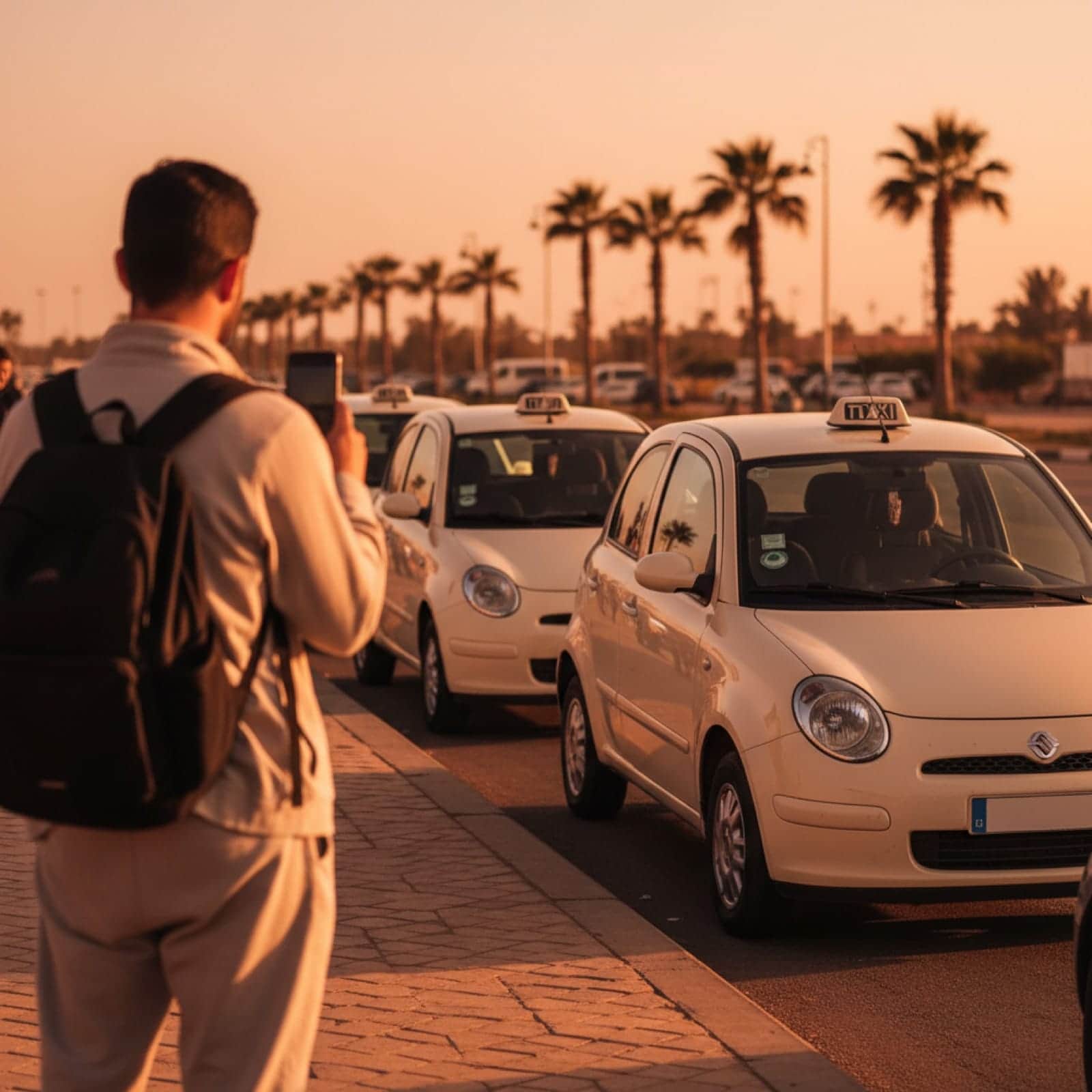
Petit taxis are small city taxis (sedans, painted a specific color per city — beige in Marrakech, red in Casablanca, blue in Rabat) used for short trips inside Moroccan cities. They are common and usually affordable by international standards. Two practical rules:
- Always ask the driver to use the meter ("compteur, s'il vous plaît"). If they refuse, agree on a fare before you get in.
- Petit taxis can carry up to three passengers under local rules. If you're a group of four, you'll need two cabs or a grand taxi.
- Day rates and night rates differ — night fares are roughly 50 percent higher, and that's legal.
Grand taxis
Grand taxis are larger taxis — usually old Mercedes sedans painted cream or white — used for shared routes, airport runs, nearby towns, and routes outside the petit-taxi zone. They can be confusing for first-time visitors because some are shared by seat (you pay a per-seat rate and wait until the car fills with six passengers), while others can be hired privately for the full vehicle. For airport-to-city or city-to-city routes, hiring the whole grand taxi privately is usually worth it.
Private transfers
Private transfers — pre-booked through your riad, hotel, or a tour operator — are often the easiest choice for airport arrivals, late-night arrivals, families with children, travelers with luggage, and visitors staying inside a medina. They cost more than a metered taxi, but they remove three friction points at once: language, route confusion, and the medina-access problem (in Marrakech and Fes, cars cannot reach many riad doors). If you're shopping around for a Morocco tour operator who can handle airport pickup and the rest of the trip, here are the 17 questions to ask before paying a deposit.
Trains and buses
For city-to-city travel, tourists should not think only in terms of Uber or taxis. Morocco has ONCF trains connecting Casablanca, Rabat, Tangier, Fes, Meknes, and Marrakech, including the Al Boraq high-speed line between Casablanca and Tangier. For routes not covered by train, the major bus operators are CTM and Supratours — both reliable and tourist-friendly. Booking online a few days ahead is straightforward.
Uber vs Careem vs inDrive vs taxis in Morocco
When deciding what to use in the moment, the trade-offs look like this:
| Option | Best for | Pros | Cons |
|---|---|---|---|
| Uber | Casablanca and Marrakech, if the app shows service | Familiar interface, transparent route | Limited availability, not nationwide |
| Careem | Larger cities | App-based rides, Morocco listed as supported | Coverage varies by city |
| inDrive | Negotiated-price rides | Often practical and flexible | Price negotiation can be unfamiliar |
| Petit taxi | Short rides inside a city | Common, affordable | Meter refusal or tourist pricing can happen |
| Grand taxi | Shared or intercity routes | Useful outside city centers | Confusing for first-time tourists |
| Private transfer | Airports, late nights, luggage, medina stays | Reliable, pre-arranged, no language friction | More expensive |
| Train / bus | City-to-city travel | Better for long distances, often cheapest | Not door-to-door |
What should tourists use from the airport?
For your first arrival in Morocco, the safest and least-stressful option is usually a pre-arranged hotel pickup or private transfer, especially if you land late, carry luggage, or do not speak French, Arabic, or Darija. After your first day on the ground, you can comfortably compare official taxis, Careem, inDrive, or Uber where available.
Quick cost reality (Marrakech airport to medina, 2026):
| Option | Typical cost | Friction |
|---|---|---|
| Uber / Careem if available | $6–12 | Variable — drivers cluster in Gueliz, often no pickup at the airport |
| Official petit taxi (meter) | $10–15 day · $15–20 night | Meter haggle, no riad-door access |
| Pre-booked private transfer | $25–35 | Lowest — name sign at arrivals, porter to the riad door |
Want a private driver for the whole trip? → tell us your dates. One driver, one car, every leg of the route — no daily haggling.
| Traveler type | Best airport option |
|---|---|
| First-time visitor | Hotel pickup or private transfer |
| Solo traveler arriving late | Hotel pickup or private transfer |
| Budget traveler arriving daytime | Official taxi (use the meter) or public transport where available |
| Family with luggage | Private transfer |
| Experienced Morocco traveler | Taxi app, official taxi, or pre-negotiated grand taxi |
City-by-city transport advice
Marrakech
Use official petit taxis (beige), hotel-arranged transfers, Careem or inDrive if available, and Uber if the app shows service in your area. For airport arrival, pre-booking is almost always worth it — especially if your riad is inside the medina, where cars cannot reach the door and you'll need a porter to walk you in. We wrote the full playbook on this in Marrakech airport transfer: private car, taxi, shuttle, or train. See our Marrakech destination guide for the full first-timer playbook, or browse tours from Marrakech if you want the airport pickup included by default.
Casablanca
Casablanca is the Moroccan city where app-based transport is most likely to be useful. Uber and Careem both have meaningful coverage. Also consider official red petit taxis and the Casablanca tram for north-south routes. If you're flying into Casa-Mohammed V and onward to Marrakech, the Al Boraq train via Casa-Voyageurs is usually the right call. For travellers landing here to start a multi-day route, see tours from Casablanca.
Tangier
Do not rely on Uber in Tangier. Use official petit taxis, hotel pickup, private transfers, or local transport depending on your route. The taxi ranks at Tangier Ibn Battouta Airport (TNG) are well-organized and use a posted fare table for the most common destinations.
Fes
For Fes medina stays, your riad pickup instructions matter far more than any app. Cars often cannot reach the exact riad door — the medina alleys are too narrow, sometimes too steep. Ask your riad to send a porter to a named gate, and quote that gate to your taxi driver. See our Fes destination guide for the full medina playbook.
Rabat
Rabat is usually calmer than Marrakech or Fes for first-time visitors. Use blue petit taxis, the Rabat-Salé tram for the main north-south corridor, and ride-hailing apps where they work. Inter-city train connections to Casablanca and Tangier are excellent.
Agadir
Taxis and hotel transfers are usually more predictable than ride-hailing in Agadir. Check Careem and inDrive when you arrive, but plan around the assumption that you will use official taxis for most trips. Agadir is also the closest hub to our Tafraoute almond-blossom route.
Chefchaouen
Chefchaouen is walkable once you arrive. Inside town, you don't need a ride at all — most streets are too narrow for cars anyway. For arrival and departure, use CTM buses, shared grand taxis, or pre-booked private transfers. The nearest airports are Tangier (TNG, ~2.5 hours) and Fes (FEZ, ~3 hours). See our Chefchaouen destination guide for more.
Is it safe to use ride-hailing apps in Morocco?
For tourists, the main issue is usually not personal safety inside the app. The bigger issues are reliability, availability, pickup location, price clarity, and occasional friction with traditional taxis (who have, in some cities, been resistant to ride-hailing services). When using any app, check the plate against the booking, confirm the destination with the driver, avoid arguments with non-app taxis at official taxi stands, and choose pickup points the app suggests rather than improvising. Rules and local acceptance can vary by city — this is one of those topics where what's true in Casablanca is not always true in Tangier.
What to do if Uber does not work
If you open Uber and there are no drivers nearby, your options in order of practicality:
- Check Careem — it often has coverage where Uber doesn't, especially in Casablanca and Marrakech.
- Check inDrive — try negotiating a fair price, not the lowest possible price.
- Ask your hotel or riad to call a taxi for you. This is standard hospitality in Morocco.
- Walk to an official petit taxi stand and use the meter (or agree on the fare first).
- For airport arrivals or late nights, book a private transfer through your accommodation.
- For city-to-city travel, take an ONCF train or a CTM/Supratours bus.
Common tourist mistakes
Assuming Uber works everywhere
Uber availability in Morocco is not like in Europe, the US, or the Gulf. Even in cities where Uber has returned, drivers cluster in specific neighborhoods. Always have a backup plan — a hotel number, a hailable taxi route, a riad contact.
Landing at night with no transport plan
If you arrive after 21:00, book a hotel pickup or private transfer before you leave home. Late-night taxi fares are higher (legitimately so), language friction is worse, and you don't want to negotiate from a position of fatigue with luggage.
Getting into a taxi without confirming the price or meter
For city petit taxis, ask for the meter ("compteur"). If the driver refuses, get out and find another cab — there are always more. For longer rides or unmetered cars, agree on the fare before the door closes.
Expecting cars to reach every medina hotel
In Marrakech, Fes, and Chefchaouen, many riads are inside narrow medina streets where cars cannot enter. Your driver will drop you at the nearest gate. Ask your riad in advance for the exact drop-off point and pickup instructions — including whether they'll send someone to meet you.
Only checking one app
Try Uber, Careem, and inDrive in the same minute if the first one returns nothing. Coverage between apps is uneven — a driver who's idle on Careem might not be on Uber, and vice versa.
Final recommendation
If you are visiting Morocco, do not plan your trip assuming Uber will work everywhere. Check Uber when you arrive — especially in Casablanca or Marrakech — but prepare alternatives. For most tourists, the best strategy is: use app-based rides where they work, official metered taxis for short city trips, hotel or private transfers for airport arrivals and late nights, and ONCF trains or CTM buses for travel between major cities.
Planning a private Morocco trip? Tell us your dates and we'll handle the transport logistics end-to-end — airport pickup, driver-guide, transfers between cities, and the right vehicle for each leg of the route. No taxi haggling, no medina-gate confusion.
Written by
Youssef El Alaoui
Lead Morocco Specialist
Born in Fes, based in Marrakech. Designs private itineraries for Morocco Beauty Spots and still argues mint tea is best in the Atlas.