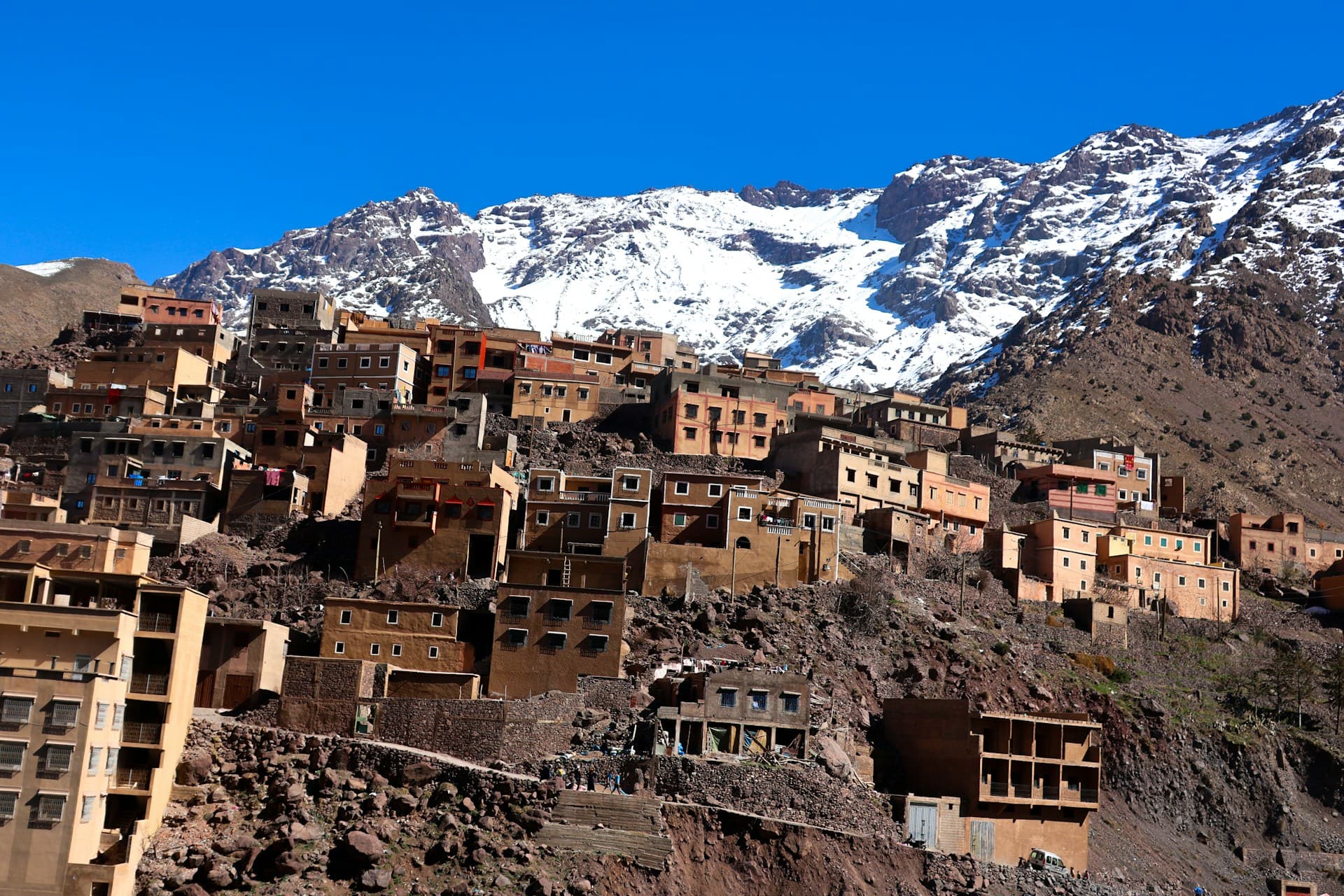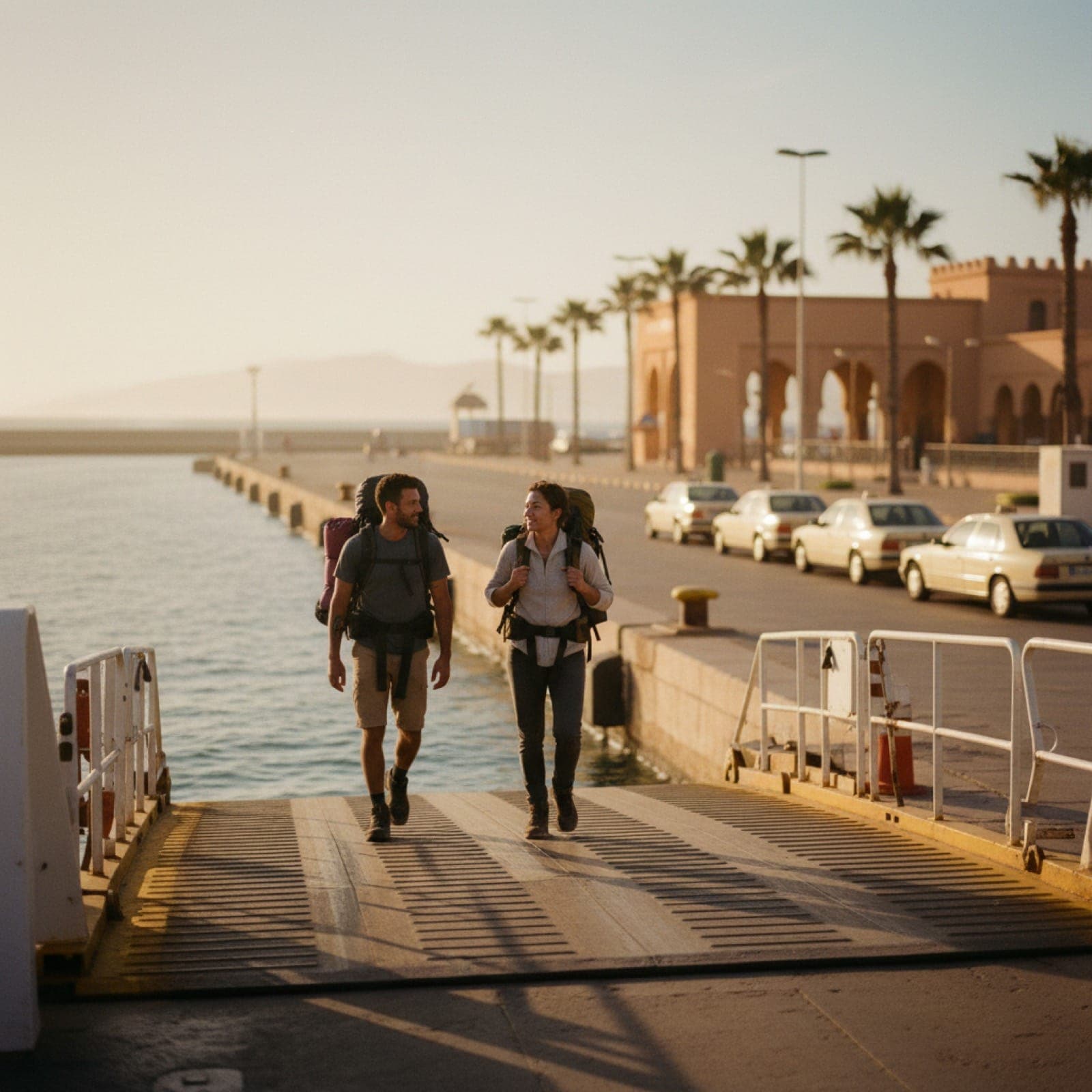
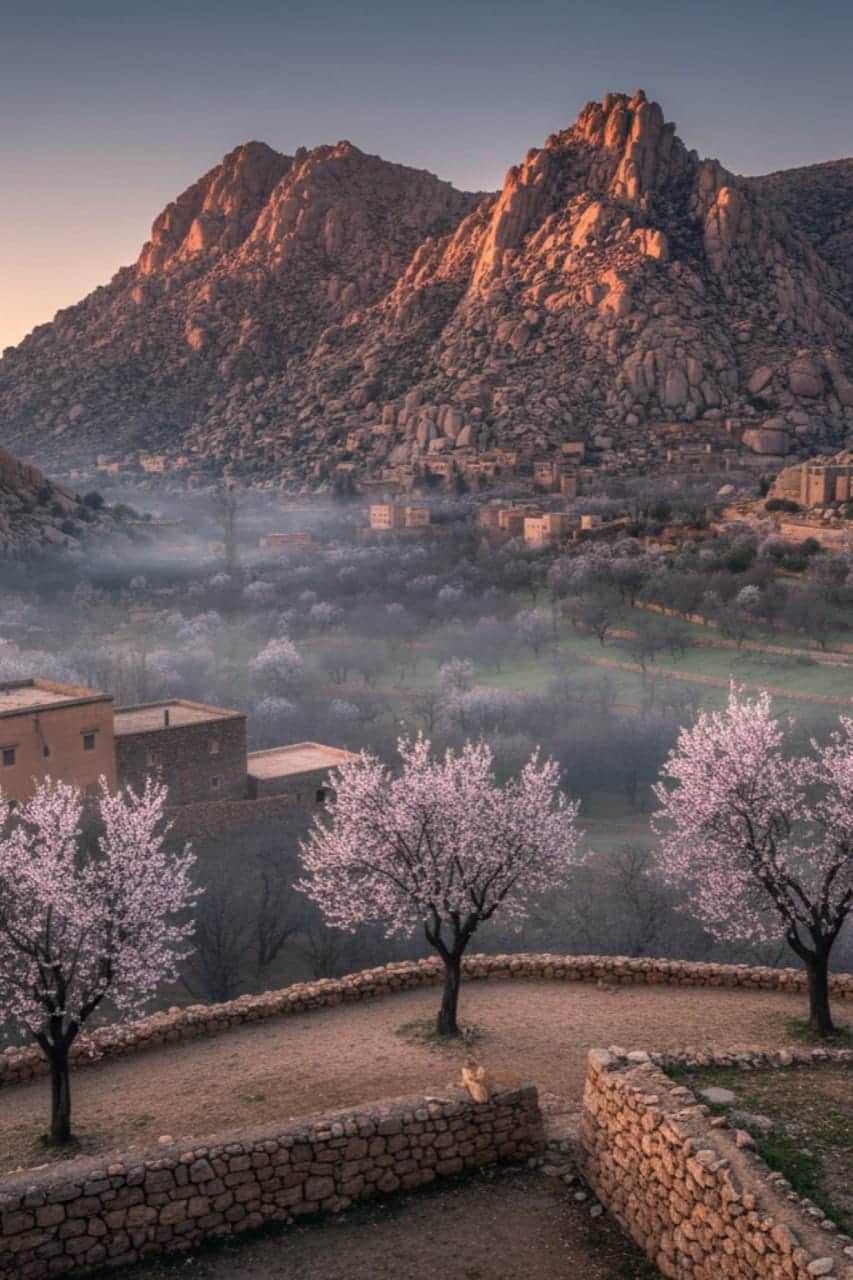
Tafraoute's Anti-Atlas valleys turn pink for two weeks every late February. A local's 2026 guide — peak dates, the four valleys to walk, where to stay, what to pack, and the trip we plan around it.
“Tafraoute's almond trees bloom for two weeks every late February, when the Anti-Atlas valleys around the town turn pink under cool mountain mornings. The peak window in 2026 runs roughly February 10–25; plan three days minimum, base in Tafraoute itself (≈1,200 m altitude, population around 5,000), and book accommodation 60 days ahead — there are fewer than 200 quality beds in town. This guide walks through the pink two-week window: the four valleys worth seeing, the exact route we plan, and the eight things every traveller asks about Tafraoute before they book.”
— Youssef El Alaoui — Lead Morocco Specialist at Morocco Beauty Spots, ten years on the ground
There's a fortnight every February when the southern Anti-Atlas looks like nowhere else in Morocco. The almond trees — Prunus dulcis, planted in stone-walled terraces by generations of Berber families — break into pink-white bloom across the valleys around Tafraoute, a small town set into the granite at 1,200 metres. For two weeks, the entire region is a colour you don't associate with Morocco: pale rose against red rock against deep mountain blue.
It is the quietest decisive moment in the Moroccan tourism calendar. There are no buses. There is no crowd. The almond-blossom window draws Moroccan families and a handful of European hikers — almost no international planners book around it, because almost no international planners know it exists. That gap is the reason this guide is written.
When does Tafraoute's almond blossom actually peak?
The honest answer is late February, with year-on-year variation of about a week in either direction depending on winter rainfall and night-time temperatures at altitude.
The bloom is triggered by a specific sequence: a wet December–January followed by a stretch of mild daytime temperatures (15–22 °C) and cool nights (4–9 °C) at the end of January. When those conditions hold, the trees in the lower Ameln Valley (≈1,100 m) start to flower first, around February 5–12. The upper valleys around Aguerd Oudad (≈1,400 m) follow about a week later, peaking February 12–22. By the first week of March, the petals are on the ground and the leaves are coming in.
Our records for the past two years and the 2026 forecast:
- 2024: first open blossoms Feb 4 · peak window Feb 14–22 · last colour Mar 2
- 2025: first open blossoms Feb 7 · peak window Feb 16–24 · last colour Mar 4
- 2026 (forecast): first open blossoms Feb 8–10 · peak window Feb 14–25 · last colour early March
A practical 2026 booking note: aim for arrival between February 12 and 22. That window catches both the lower and upper valleys at peak simultaneously. Earlier in the month and the upper valleys are still bare; later and you're chasing the last petals in the lower groves.
The Festival des Amandiers en Fleurs (Almond Blossom Festival), held in Tafraoute since 1962, traditionally times itself to the peak — the dates are announced about three weeks ahead by the regional commune. In 2026 the festival is expected to fall around February 20–22; we recommend planning around the festival weekend only if you want the music, dance, and souk performance — and away from it if you want the quiet valleys at their emptiest.
Where to see the bloom — four valleys worth walking
Tafraoute sits at the geographic centre of a roughly 40-kilometre radius that includes four distinct almond-growing valleys. They are not interchangeable — each has its own character, altitude, and palette.
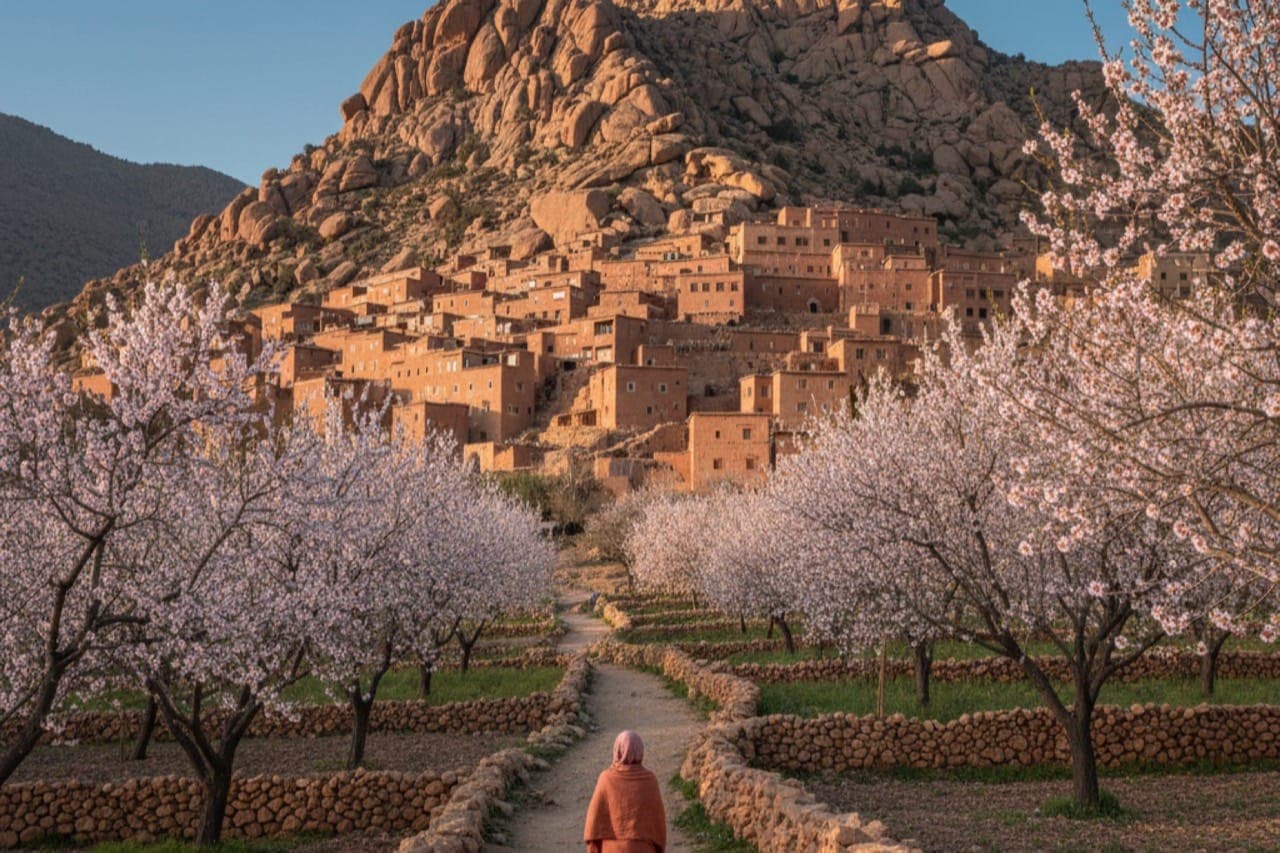
1. Ameln Valley (15 minutes north of Tafraoute)
The flagship. Twenty-six Berber villages strung along the foot of the Jebel El Kest (2,359 m) — the granite spine that locals call the Lion's Face for its profile against the sky. The valley floor is dense with almond terraces; you can walk village-to-village on dirt paths and never lose sight of a bloom. The most photogenic stretches are between Oumesnat and Tirnamt.
2. Aït Mansour Gorge (45 minutes south)
A deep palm-and-almond canyon cut into the granite. The bloom here is sparser — the canyon walls block the morning sun — but the contrast between pink almond petal and red kasbah wall is the strongest in the region. Stop at the small Aït Mansour palmery for lunch.
3. Aguerd Oudad (10 minutes south of Tafraoute)
The highest of the four valleys at around 1,400 m. The trees bloom about a week later than Ameln. Worth a half-day, mostly for the Chapeau de Napoléon (Napoleon's Hat) rock formation overlooking the village — and because the painted rocks by Jean Verame are a 15-minute drive from here.
4. Ait Souka & Tarkeddit (1 hour east of Tafraoute)
The off-trail option. Almost no foreign visitors reach these high terraced groves above 1,500 m, which means you walk among working orchards where Berber families are pruning, weeding, and watching you with curiosity. Go with a local guide — there is no signage and the dirt road requires a 4×4.
“Most people drive the Ameln Valley loop in three hours and call it a day. The valley is meant to be walked. Even half a day on foot in Oumesnat will change what you remember from the trip.”
— Hassan Amzil, our Tafraoute-based guide of nine years
How to plan a 3-day Tafraoute trip — the route we book
Three days is the minimum. Two days are enough to see the bloom but not the surrounding context (kasbah villages, painted rocks, Saturday souk). Four or five days let you go deeper into the Anti-Atlas — by car or on foot — and link the trip to a coastal start in Essaouira or a finish in Marrakech.
Day 1 — Arrive and slow down
- Morning: drive from Agadir (~3 hours via Aït Baha) or fly into Agadir Al Massira (AGA) and pick up your driver at the airport
- Afternoon: arrive Tafraoute by 14:00, settle in, walk the Saturday souk if it's a Saturday — the weekly market is the regional event
- Late afternoon: Ameln Valley sunset drive, stop at Oumesnat for the Maison Traditionnelle — a small ethnographic museum in a converted Berber house (€2 entry, 45 minutes)
- Dinner: at your kasbah hotel. Order the amlou — the local Anti-Atlas spread of crushed almond, argan oil, and honey
Day 2 — The bloom, on foot
- Pre-dawn (6:30 a.m.): depart for the Ameln Valley with your guide and a thermos of mint tea. Sunrise behind Jebel El Kest is the photograph you came for
- Morning: walk from Oumesnat to Tirnamt via the dirt path through the almond groves (~5 km, 2 hours, easy gradient)
- Lunch: in a Berber family home in Tasguint — pre-arranged. Tagine with seven vegetables, fresh khobz bread, the rest of the amlou you didn't finish at breakfast
- Afternoon: Aguerd Oudad and Le Chapeau de Napoléon — half a day on foot, you can climb to the base of the rock formation if you're not afraid of scree
- Evening: back to Tafraoute. Restaurant Etoile du Sud for the area's best tajine de viande à l'amandier (lamb with whole almonds)
Day 3 — Painted rocks and out
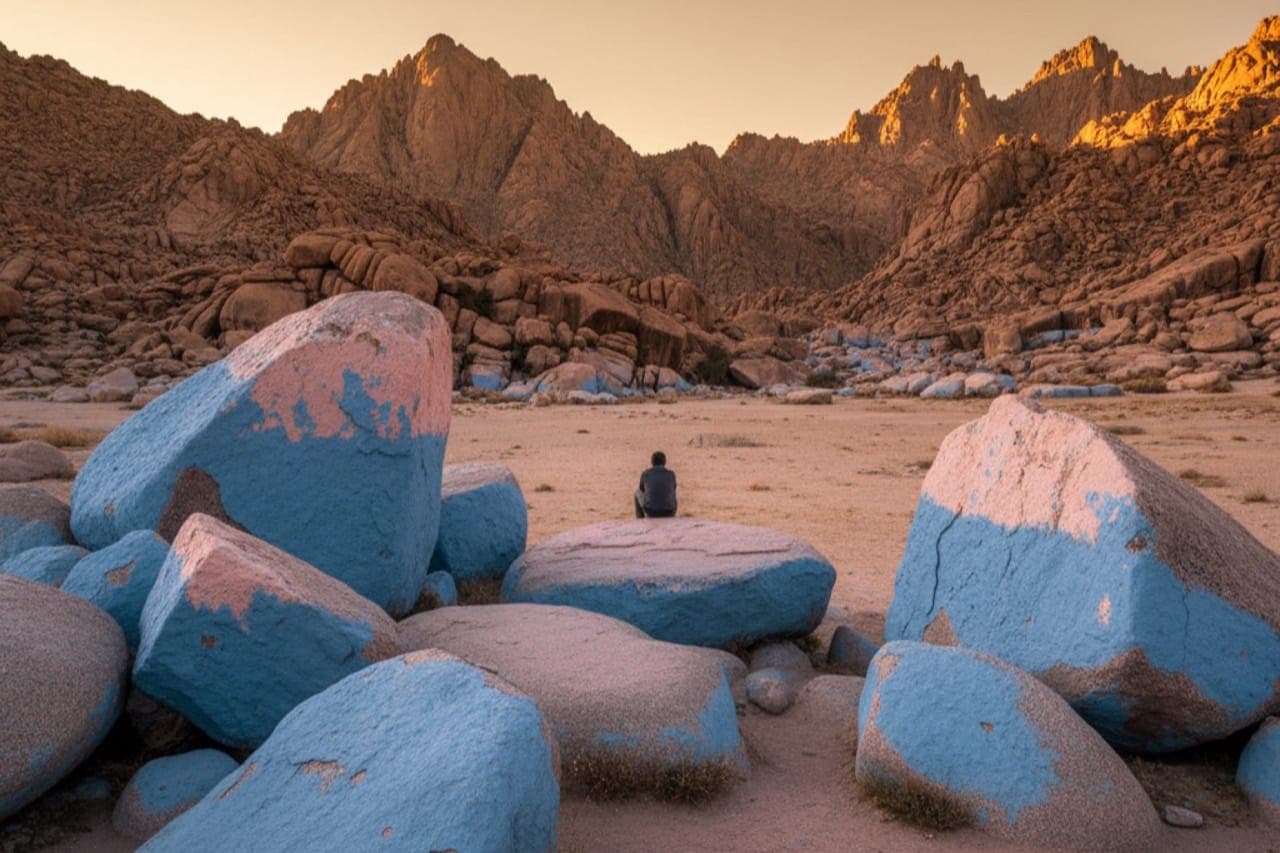
- Morning: drive 8 km south to the Painted Rocks of Tafraoute — the granite boulder field painted blue and salmon by Belgian artist Jean Verame in 1984. The paint is now half-weathered; the surreal effect is real
- Late morning: the Gazelle Rock Carvings at Tazarka — Neolithic petroglyphs dated approximately 6,000 BCE by the Moroccan Institute of Archaeological Sciences. A 20-minute walk from the parking pull-off
- Afternoon: drive back to Agadir for an evening flight, or continue north toward the High Atlas for an extended trip
For travellers booking with us, we usually extend this template to a 4-day Anti-Atlas + Tafraoute trip with an extra night in Aït Mansour for the gorge and a longer walk in the upper Ameln Valley. The structure follows the same logic as our 3-day private Fes-to-Sahara route — short distances, slow days, one anchor experience per day. If you want a wider tour built around Tafraoute, tell us your dates and we'll reply within 24 hours with a custom itinerary.
How to get to Tafraoute
Tafraoute is south of the High Atlas, deep in the Anti-Atlas, and that geography is the reason it stays quiet — there is no direct flight, no train, and the road in winds through 60 kilometres of granite.
- Agadir (AGA airport): ~3 hours, 145 km. Easiest, best paved road, our standard entry point
- Marrakech (RAK): ~7 hours, 470 km. Long but scenic via Taroudant — break the drive with a night in Taroudant
- Casablanca (CMN): ~9 hours, 720 km. Take the ONCF train Casablanca–Marrakech (3h), then drive
- Taroudant: ~3 hours, 175 km. Good Anti-Atlas base if you want to extend
- Tiznit: ~1.5 hours, 90 km. Quick mid-route stop for the silver souk
There is also one direct CTM bus from Casablanca to Tafraoute (~14 hours, leaves Casablanca evening, arrives Tafraoute morning). Local grand taxi runs Agadir–Tafraoute via Aït Baha for around 100 dirhams (~€9), shared with up to five other passengers. Both are functional if you're on a tight budget; for our $4–8k tour guests, the licensed driver-guide from Agadir is standard.
The Tafraoute road is paved the entire way from Agadir, but climbs steeply for the last 40 km — winter mornings can have ice patches above 1,000 m, and the drop-off on the right side of the switchbacks does not have a guardrail in places. This is one reason we do not recommend renting a car for this part of Morocco.
Where to stay in Tafraoute
There are fewer than 200 quality rooms in Tafraoute proper. Plan to book at least 60 days ahead for the bloom window; for the festival weekend itself, 90 days. Three categories worth knowing:
Mid-range kasbah-style (€55–110 / night, double)
- Hôtel Les Amandiers — the town landmark. Built in the 1970s as a pink kasbah, refurbished in 2018. Pool. Best terrace view of Tafraoute
- Auberge Chez Amaliya — Berber-family-run, smaller, quieter. Outside town in the Ameln Valley
Boutique riad / guesthouse (€90–180)
- Kasbah Tizourgane (45 minutes south, on the road to Tiznit) — restored 14th-century hilltop kasbah, ten rooms. Worth a night at the end of the trip for the sunset over the Anti-Atlas plain
- Maison Traditionnelle d'Oumesnat — three rooms inside the museum-house in the Ameln Valley. Books out months ahead
Berber-family homestay (€25–45)
Arranged through our local team or cooperative networks. The standard is clean, simple, and warm in winter. Worth one night for the experience; not for the full trip.
Tafraoute has limited hot-water capacity at altitude in winter — the second shower in the day is often cooler than the first. Pack a fleece for evenings inside the room. Wi-Fi at all categories is patchy; mobile data on Maroc Telecom 4G is more reliable.
What else to see while you're there
The Painted Rocks of Tafraoute (Pierres Bleues)
In 1984, Belgian conceptual artist Jean Verame painted a granite boulder field 8 km south of Tafraoute in ultramarine blue and salmon red — about 18 tonnes of paint. The work was repainted briefly in 1989 and has weathered naturally since. The colours are now faded and ghostly, which is most of the point. A surreal half-day; pair with sunset.
Gazelle Rock Carvings
Neolithic petroglyphs at Ukas, dated to around 6,000 BCE by the National Institute of Archaeological Sciences (INSAP) in Rabat. Two main panels: gazelles, elephants, and a now-rare prehistoric ostrich. 20 minutes' walk from the road pullout. Bring water; the path is open scree.
The Saturday souk
Tafraoute's weekly market starts at sunrise and is over by 12:00. The categories: dates from the Aït Mansour palmery, argan oil from the Berber women's cooperatives (the certified ones, not the roadside stands), Anti-Atlas silver jewellery (Berber dowry tradition — fish-bone and triangle motifs), and almonds in every form imaginable. Bring small bills.
What to pack for a late-February Tafraoute trip
The Anti-Atlas in February is mountain weather at low-Sahara latitude. The temperature swing between morning and afternoon can hit 18 °C; pack for both ends.
- Layers: a thermal base, mid-fleece, and a light shell. Mornings 4–8 °C; midday in sun 18–22 °C
- Walking shoes, not sneakers — the Ameln Valley paths are stony
- A scarf long enough to wrap as a cheche (sun + dust + Berber-family respect)
- Small daypack with water, snacks, sunscreen, lip balm — dry air at altitude is harder on your skin than the Sahara
- Head torch: village street lighting is irregular after 21:00
- Cash: Tafraoute has two ATMs (BMCE, Attijariwafa) in the town centre. Bring backup cash for outside-town purchases. Many homestays accept dirham cash only
- Modest dress for visiting villages — knees and shoulders covered is standard outside hotel grounds
- Camera with a 35–85mm lens; the bloom is at human scale, not landscape scale
Practical notes — weather, mosques, etiquette
Weather (late Feb, multi-year averages): daytime highs 18–22 °C, lows 4–9 °C, rainfall 30–60 mm for the month (usually concentrated in early February). Sky is clear roughly 70% of February days; the photography window between 7:30 a.m. and 10:30 a.m. is the most reliable.
Mosques and prayer times: Tafraoute has two main mosques. Both close to non-Muslim visitors. The dhuhr (midday) prayer call is the loudest in town because the speaker on the main mosque was renovated in 2023; expect a 90-second amplified call around 13:00 — beautiful, but don't have a sleeping baby in a window-facing room.
Etiquette in Berber homes: Salaam on entry; remove your shoes; accept the first tea (you can decline the second pour, never the first); never photograph faces without asking — and even then, often the answer is "not the children". Bring a small gift if you've been invited to a meal — tea, sugar, or something practical from a city store works better than craft trinkets.
Connectivity: Maroc Telecom and Inwi 4G coverage is reliable in Tafraoute town and patchy in the valleys (no signal in Aït Mansour Gorge). Wi-Fi in hotels is real but slow. If you need a working day, plan it for Day 1 in town, not Day 2 in the valleys.
What this trip costs in 2026
For a private custom trip with a licensed driver-guide, all transfers from Agadir, mid-range kasbah-style accommodation (Hôtel Les Amandiers tier), and meals at our partner restaurants, the rough 2026 per-person price range:
- 2 travellers (couple): €690–890 (3 days) · €890–1,150 (4 days)
- 4 travellers (friends): €490–620 (3 days) · €640–810 (4 days)
- 6 travellers (small group): €420–540 (3 days) · €560–710 (4 days)
Solo travellers and groups of 5+ are quoted bespoke. Add roughly €180–240 per person for the 4-day Anti-Atlas + Tafraoute route described above.
These prices include the things we never see broken out in standard listings: licensed driver, fuel, parking and police-checkpoint fees, accommodation with breakfast, four restaurant lunches (the rest are family-home meals included in the route), entrance fees for Maison Traditionnelle and Painted Rocks parking, and the local guide for the on-foot Ameln Valley walk. They do not include flights or travel insurance.
Why this trip is worth planning
There is a particular kind of traveller who books with us a second time after their first Moroccan trip. They're usually returning travellers — they've done the Marrakech-Sahara-Fes loop, slept under the stars at Erg Chebbi, eaten the right pastilla in the right riad. They come back asking for what's next.
Tafraoute is what's next. The bloom is a two-week argument that the most photographed country in North Africa still has corners that look like nowhere else, that there are entire valleys where the only English you'll hear is your own, and that the slowness of the place is what makes the visit. The Anti-Atlas does not compete with the High Atlas; it does not try to. It simply offers the version of Morocco where the granite is pink, the mountains are bare, and February turns the orchards into one long colour for two weeks.
If you've been to Morocco once and want to see it again, this is the trip we plan.
Questions, answered
When is the best time to see Tafraoute's almond blossom in 2026?
The peak window in 2026 is February 14–25, with year-on-year variation of about a week. The lower Ameln Valley (1,100 m) flowers first, around February 5–12; the upper valleys at 1,400 m peak a week later. Aim to arrive between Feb 12 and Feb 22 to catch both at once.
How many days do you need in Tafraoute?
Three days is the minimum for the bloom plus the surrounding context (painted rocks, Saturday souk, one off-trail valley). Two days only gets you the Ameln Valley loop. Four or five days lets you go deeper into the Anti-Atlas — Aït Bouguemez, the M'Goun valleys, or extending to a coastal start in Essaouira.
Is the Tafraoute Almond Blossom Festival worth timing for?
It depends on what you want. The Festival des Amandiers en Fleurs — held annually since 1962, usually the third weekend of February — adds music, Berber dance, and a large souk to the town centre. If you want the cultural-festival experience, time for it. If you want the valleys at their emptiest, come the week before or after.
How do you get to Tafraoute from Agadir?
The standard route is a 3-hour drive from Agadir Al Massira airport (AGA) via Aït Baha — 145 km on paved road. We pick up guests at the airport and arrange the transfer with a licensed driver. CTM bus and shared grand taxi also run the route for budget travellers.
Is Tafraoute safe?
Yes, very. The Anti-Atlas region has one of the lowest reported-crime rates in Morocco. Standard small-town precautions apply — keep small valuables in your hotel safe, dress modestly when visiting Berber villages — but Tafraoute is among the easiest towns in Morocco for first-time visitors and solo travellers.
What's the weather like in Tafraoute in February?
Daytime highs 18–22 °C, night-time lows 4–9 °C at 1,200 m altitude. Rainfall 30–60 mm for the month, usually concentrated in the first ten days. The sky is clear roughly 70% of February days. Layer for an 18 °C swing between sunrise and afternoon.
Can you do Tafraoute as a day trip from Agadir?
Technically yes — 3 hours each way leaves about 5 hours on the ground. We strongly advise against it. The whole point of Tafraoute is slowness; a day-trip means missing the early-morning bloom photographs, the Saturday souk, the homestay dinner, and the way the granite changes colour at sunset. Minimum 1 night.
Is Tafraoute good for hiking?
Yes — at an easy-to-moderate level. The Ameln Valley has dirt paths between villages that climb gently from 1,100 m to about 1,400 m. The Jebel El Kest above the valley reaches 2,359 m and is a full-day technical scramble for fit hikers with a local guide. For first-time visitors, a half-day valley walk is the right scale — and if you want to go further on foot once you've done Tafraoute, our Atlas Mountains trek-with-Berbers brief covers the longer High Atlas routes.
Should I visit Tafraoute before or after Marrakech?
Most of our guests come after Marrakech — they spend 2 days in the imperial city (we map the route in our Marrakech first-timer's playbook), then drive south via Taroudant for 2 days of Anti-Atlas + Tafraoute, then finish on the coast at Essaouira (see our Essaouira wind, waves, Gnawa brief). The reverse order works too: starting in the quiet of Tafraoute and ending in the colour and noise of Marrakech makes the contrast strongest.
What about Tafraoute outside the bloom window?
The town is worth a visit any month of the year, but the bloom is the singular reason to plan a trip around late February. Other strong windows: April–May (snowmelt streams, full leaf, mild weather), September–November (cool evenings, harvest, the date palms in Aït Mansour fruit-ripe).

Written by
Youssef El Alaoui
Lead Morocco Specialist
Born in Fes, based in Marrakech. Designs private itineraries for Morocco Beauty Spots and still argues mint tea is best in the Atlas.