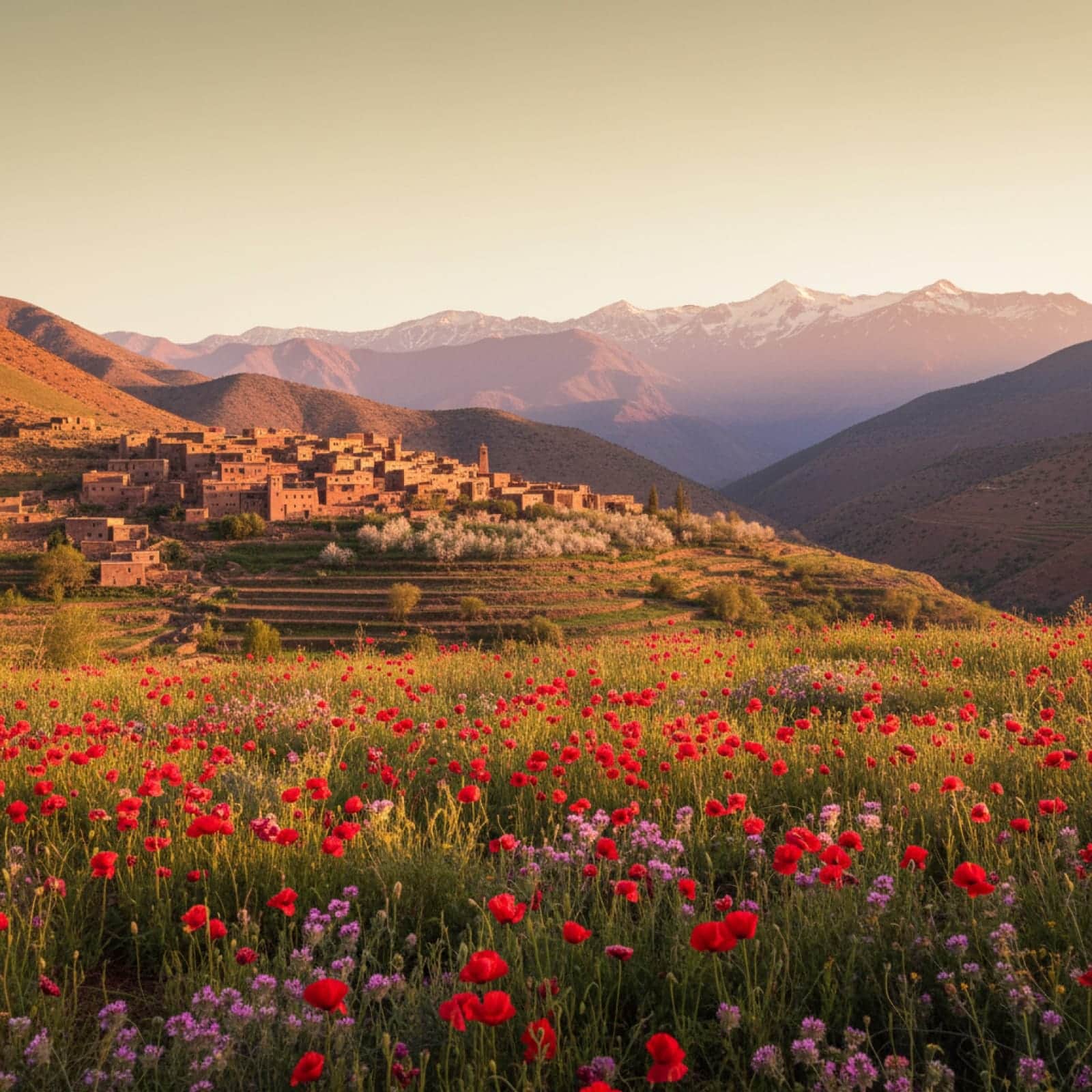
When Atlas snowmelt hits 1,800 m, the bloom line starts climbing — poppies in Ourika's foothills first, then pink and purple scabious in the Imlil meadows, finally the alpine bands above 2,500 m by mid-May. A week-by-week local guide to Morocco's mountain spring.
Morocco's High Atlas wildflower bloom runs from late April through mid-May, with the first red poppies appearing in the Ourika Valley foothills as early as February. Across those four to five peak weeks, snowmelt at 1,800–2,800 metres triggers vast yellow and white meadows that climb the mountain week by week. This is a local guide to the bloom line — which valley peaks when, which paths are still snow-blocked, and the five species worth knowing by name.
If you're planning a Morocco trip around the spring bloom, you have a roughly four-week window. The valleys go first; the alpine meadows go last. Most operator listings smear this into a generic 'April-May' recommendation. The honest version below splits it by elevation and gives you a real week-by-week shape.
When the Atlas blooms — the snowmelt window
The bloom is driven by snowmelt, not by the calendar. In a normal year (winter snowpack between 1,200 and 1,800 mm at mid-elevation), the High Atlas bloom unfolds in three roughly four-week waves: lower foothills (under 1,800 m) from mid-February to early April, the main valley band (1,800–2,500 m) from mid-April to mid-May, and the upper alpine meadows (2,500–3,200 m) from late May into early June. A late winter pushes everything back by 10–14 days. A dry winter compresses the window and weakens the show. 2026 looks normal — peak bloom is forecast for the last week of April through the second week of May.
The bloom line — how spring climbs week by week
If you drive south from Marrakech in the third week of April, you'll see the bloom line as a visible band on the mountainside. Below it, the slopes are already green with leafy growth and the flowers are fading; above it, the slopes are still grey-brown and patched with snow. The band itself — usually 100–200 metres of vertical — is where the flowers are concentrated. Each week it climbs about 80–120 metres. By mid-May the line has reached the Toubkal refuge zone at 3,200 m. Knowing the band's altitude on a given week is the difference between a trip-of-a-lifetime meadow and a 'we came too early' day-trip.
Ourika Valley — the first 45 minutes of the bloom
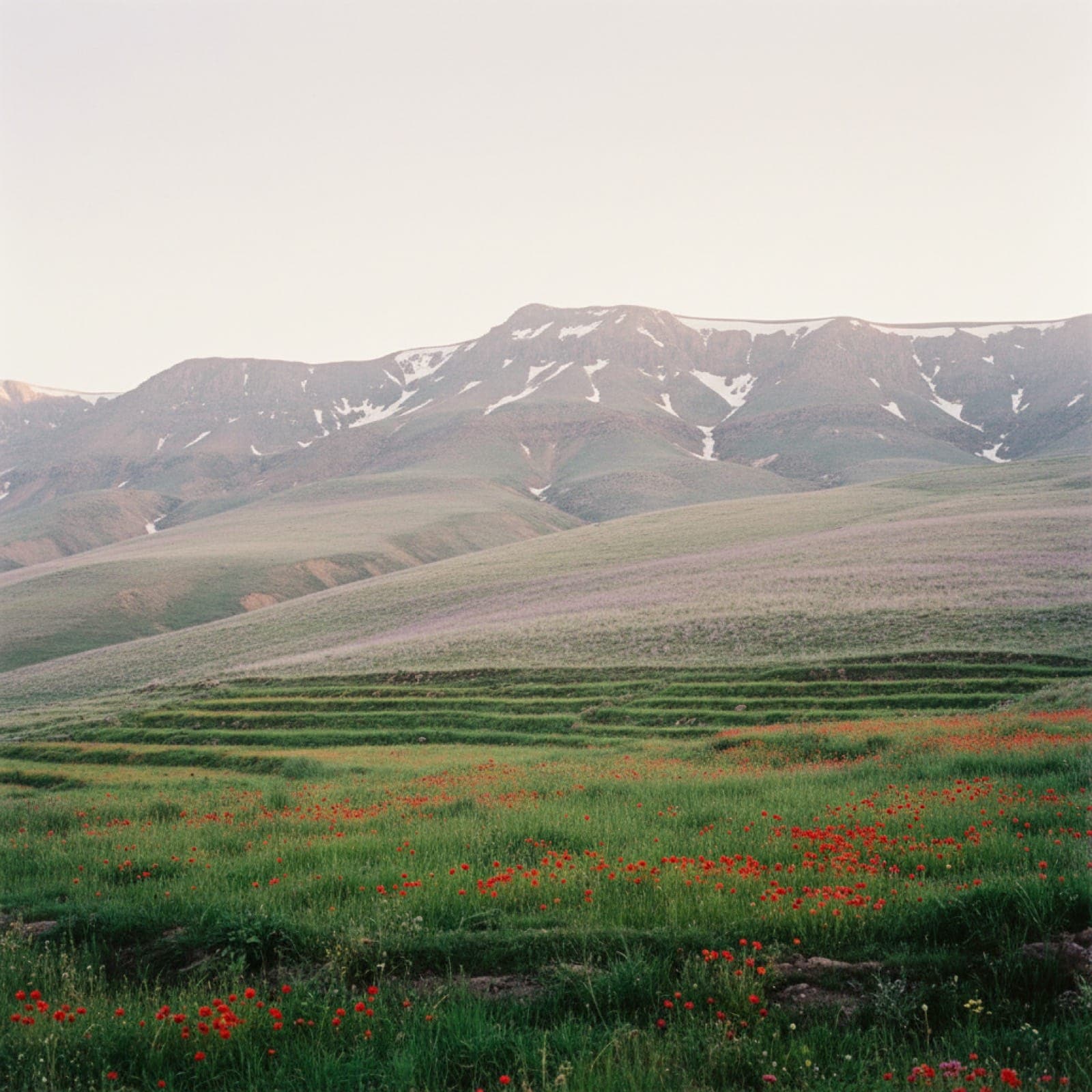
The Ourika Valley is the most accessible bloom destination in Morocco. 45 minutes to one hour south of Marrakech by road, the valley stretches 68 km from the Atlas foothills up to the village of Setti Fatma at 1,500 m. The valley floor is a continuous ribbon of terraced fields, walnut and cherry orchards, and Berber villages — most of which are mid-bloom by the second week of April, when the lower terraces fill with red poppies and the first wild irises appear in the irrigation channels. From late March through mid-May, the Ourika is the easiest place in Morocco to see real Atlas wildflowers without serious hiking.
If you're choosing between a single bloom day-trip and a multi-day Atlas loop, Ourika is the right single-day call. If you have three or more days, treat it as the first stop on the bloom-line tour.
Five wildflowers to know by name
Across the High Atlas bloom belt, five species do most of the visual work. Learning to recognise them — and where in the elevation band each one peaks — turns a 'pretty flowers' day into a real botanical landscape.
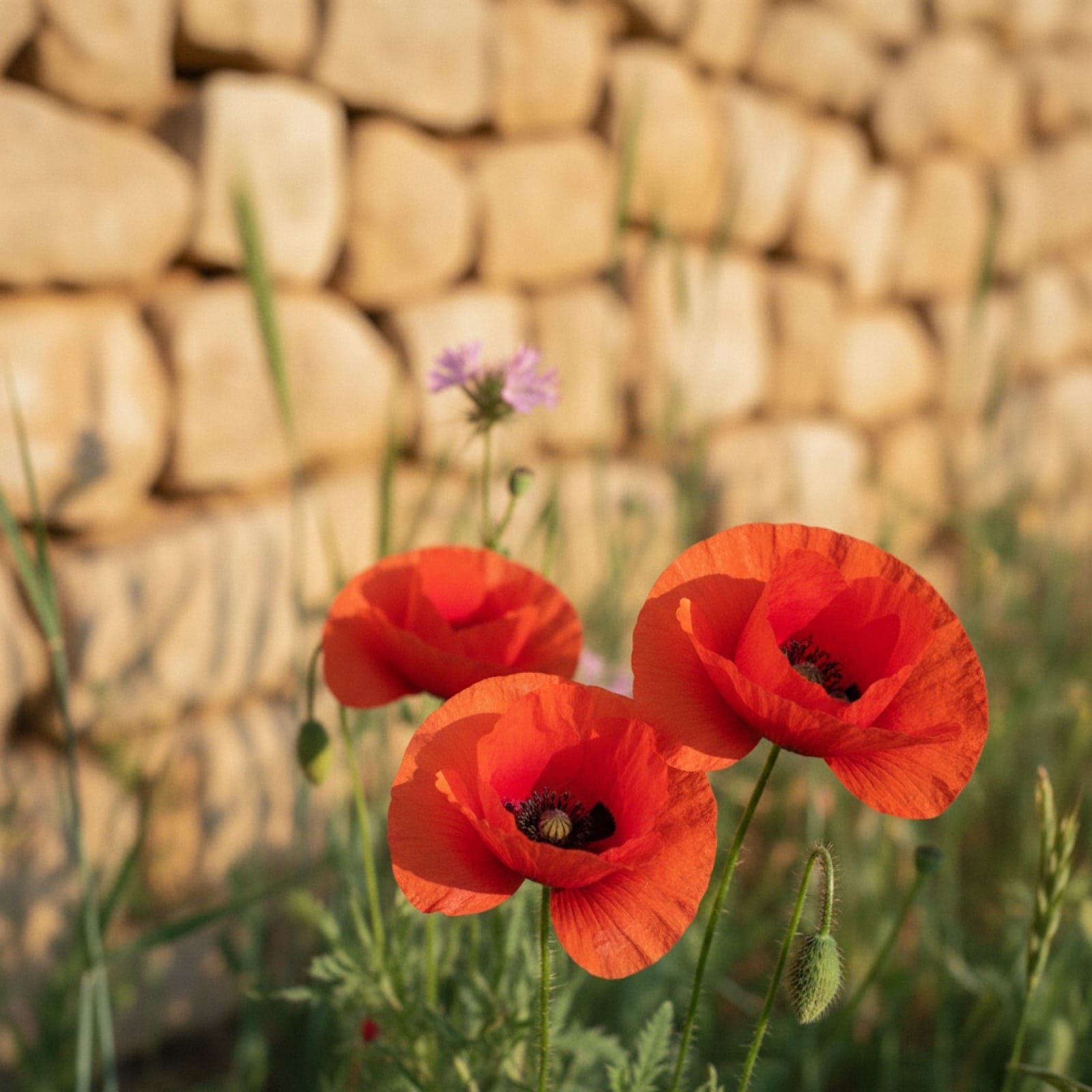
- Red poppy (*Papaver rhoeas*). The signature of the lower foothills. Appears as early as February in the Aghbalou terraces; carpets the valley floors through April. The most photographable species — best at low golden-hour light against a Berber stone wall.
- Wild orchid (various Orchis and Ophrys species). The Ouirgane and Three Valleys area is the orchid hotspot. Peak in mid-April. Subtle — they grow in scattered clumps rather than carpets, so a guide who knows the spots is genuinely useful.
- Blue gentian (Gentiana species). The signature alpine flower above 2,200 m. Peaks in early to mid-May in the Imlil meadows. Small but vivid — the deepest blue you'll see in Morocco.
- Pink and purple scabious (Scabiosa species). The most generous bloomer of the mid-elevation belt. Carpets entire hillsides at 1,800–2,500 m through the last two weeks of April and the first week of May. Photographs best as wide landscape.
- Almond blossom (*Prunus dulcis*). Different bloom, different region — almond is mostly a late-February event in the Anti-Atlas (see our Tafraoute almond-blossom guide for that one) — but a few orchards in the lower Ourika and around Asni catch a second late-March wave that often overlaps with the first Atlas wildflowers.
Aghbalou and the poppy foothills (February–March wave)
Aghbalou is a small Berber village 20 km up the Ourika Valley, sitting on the lower terraces at around 1,200 m. It catches the bloom earliest — poppies appear in the wheat-and-barley fields here in late February in a normal year, two to three weeks before anywhere else in the Atlas. From late February through mid-March, Aghbalou is the only Atlas village where you can reliably see the bloom in volume. It's also a working agricultural village, not a tourist stop, so the photography opportunity is genuinely uncurated. Combine an Aghbalou morning with a lunch at one of the Setti Fatma riverside tagine spots for an easy full-day loop from Marrakech.
Ouirgane and the wild-orchid trails (April wave)
Ouirgane is one valley west of Imlil, at the Asni junction roughly 1h 15min from Marrakech. The valley floor sits at 1,000 m; the slopes climb to 2,000 m. From early to mid-April, the mid-elevation pastures here turn into a wild-orchid hotspot — Orchis morio, Ophrys lutea, and several less common species cluster around the goat-grazed meadows above the village. Few operators stop here; most rush travellers up to Imlil for the Toubkal-summit photo. If you specifically want orchids, this is the valley. Local guides from the Ouirgane lodges can show the best clumps within a half-day's walk.
Setti Fatma and the seven waterfalls (April–May wave)
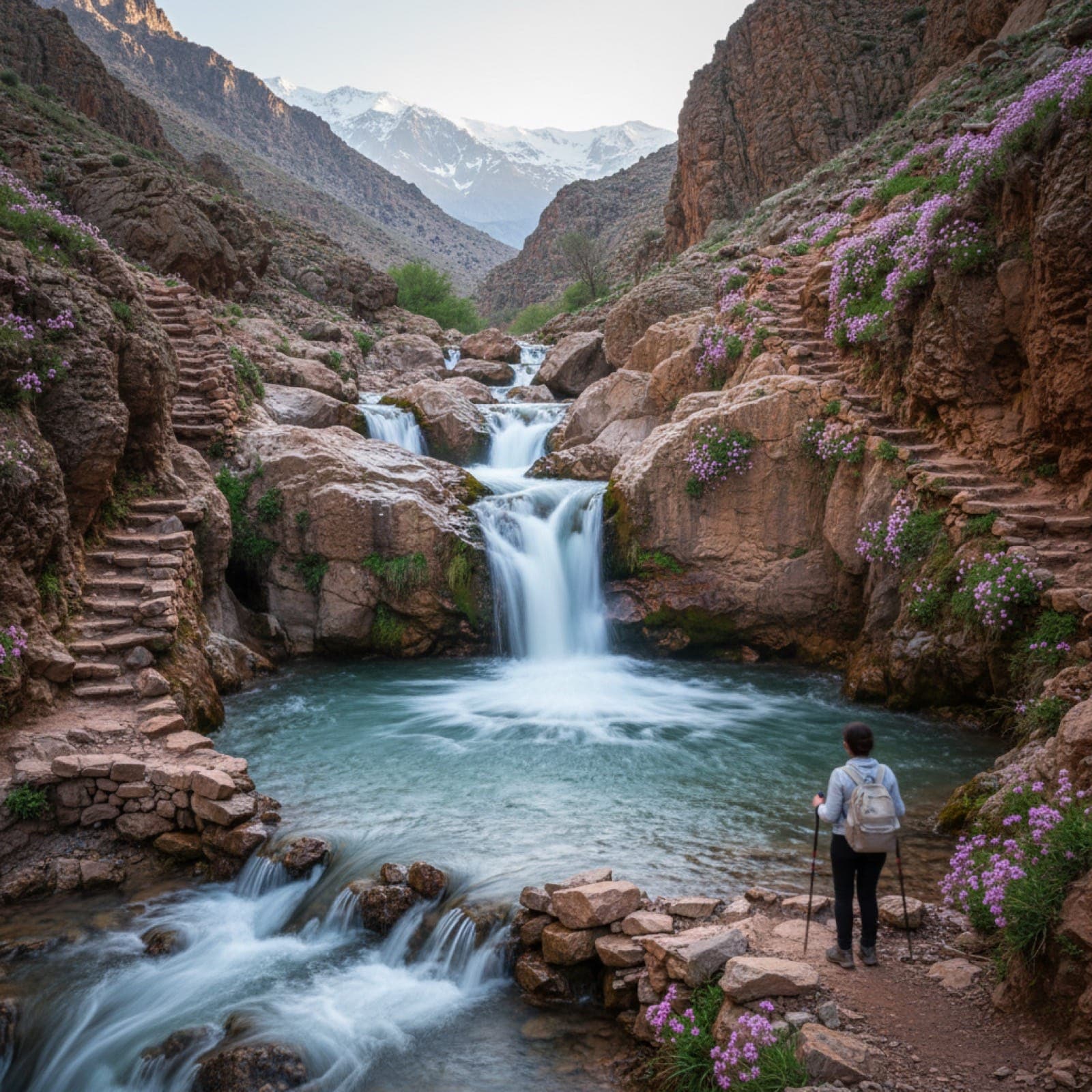
The end of the Ourika Valley is the village of Setti Fatma, where the road stops and a hiking trail climbs the gorge to a chain of seven cascades. The first waterfall is about a one-hour walk from the village over stone-bridge stream crossings. The trail's bloom peak runs late April through early May — pink scabious carpets the lower sections; alpine grasses and yellow composites take over above the fourth waterfall. The hike to the first cascade is family-friendly; reaching the seventh requires real scrambling and a guide. The trail can be muddy from snowmelt — wear sturdy shoes, not city sneakers.
Imlil — the gateway to alpine bloom (mid-May wave)
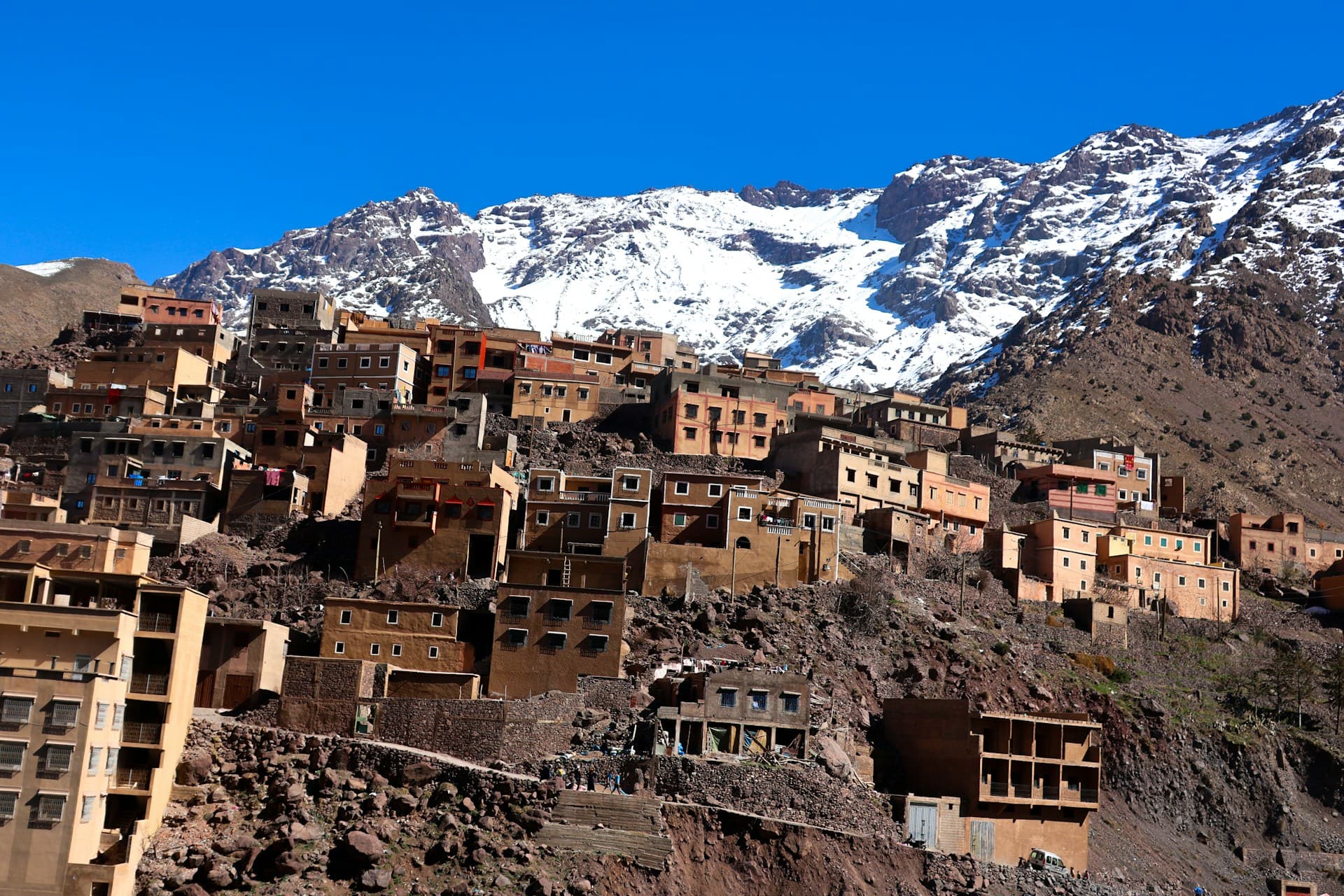
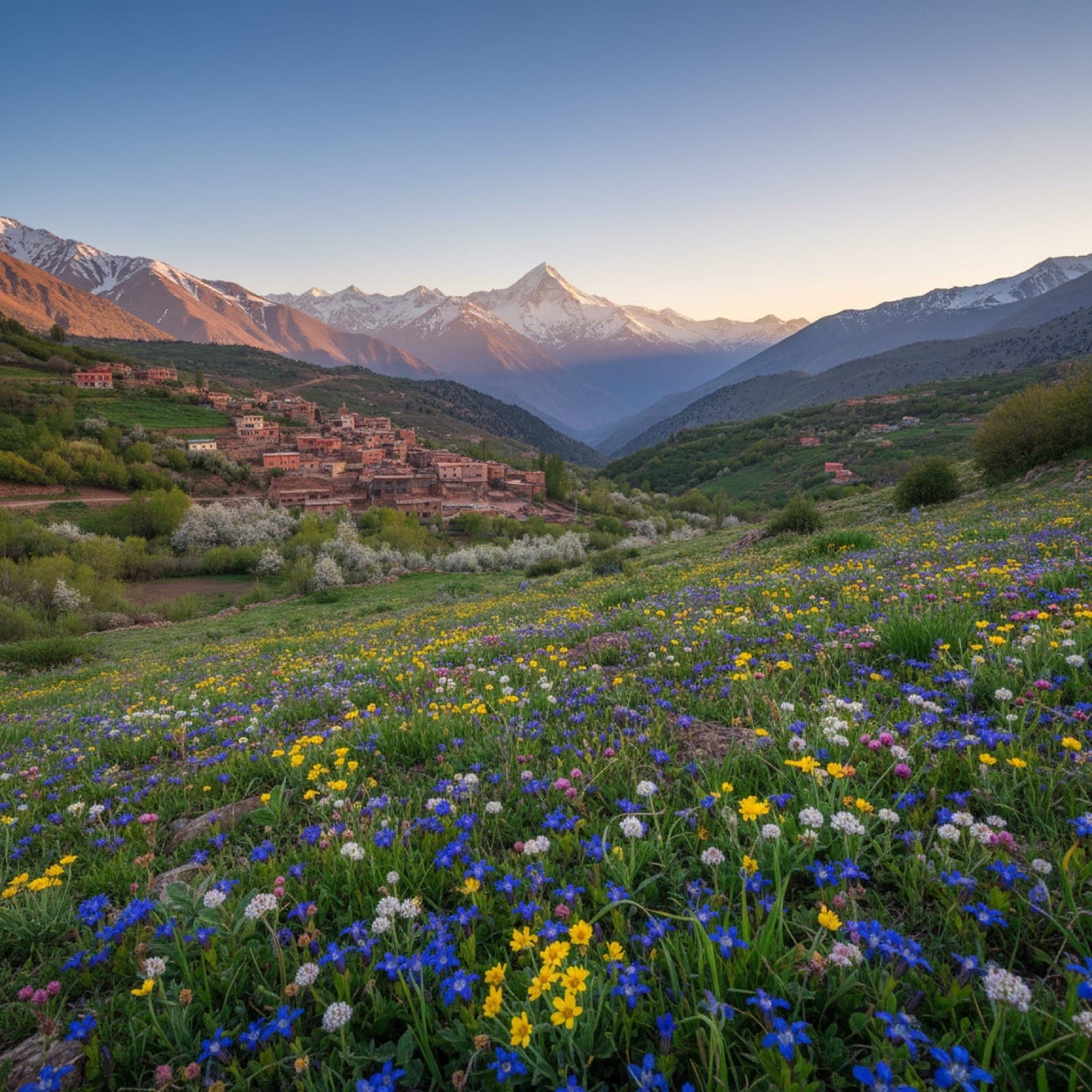
Imlil sits at 1,740 m at the head of the Mizane Valley, an hour and a half south of Marrakech. It's the main gateway to Toubkal National Park and Morocco's tallest peak. For wildflowers, it's the destination for the second half of May — the meadows above the village (2,000–2,400 m) fill with blue gentian, alpine vetch, and yellow scabious in the last two weeks of the month. Day-hike to the village of Aroumd at 1,900 m for the easiest viewing; a half-day walk above Aroumd toward the Toubkal Refuge takes you into the highest blooming band before the snow line.
The Toubkal refuge band — snow, crampons, and the highest meadows
The Refuge des Mouflons (also known as the Toubkal Refuge) sits at 3,207 m and marks the upper limit of the bloom band. By the third week of May, the meadows just below the refuge fill with the smallest and most vivid alpine flowers — gentian, alpine forget-me-not, and the tiny yellow rock-jasmine. The refuge itself is reachable as a long day-hike from Imlil (5–6 hours up, 3–4 hours down), but the route is often still snow-covered above 2,800 m into early May, and crampons are recommended through the third week of the month. Most travellers who want to see the highest meadows do an overnight at the refuge; the alternative is to hike up to the snow line, see the highest bloom band there, and turn back without summit ambitions.
Photography — golden hour by elevation
Light shapes the bloom photographs more than the species do. The Atlas sits at 31° N, so spring sun rises around 6:30 am and sets around 7:30 pm. Golden hour for the lower valleys (Ourika, Ouirgane) is 8–10 am and 5–7 pm; for the higher alpine zones, the early window shifts later because of the ridges blocking eastern light until 8:30 am. The cleanest poppy shots come from low side-light in the morning — backlight blows out the petals. Scabious carpets photograph best as wide landscape under soft mid-morning light. The bloom-line-against-snow contrast at Imlil and Setti Fatma is at its best when the snow is rim-lit at sunset.
Getting to the bloom — taxi, grand taxi, or private 4×4
Three ways into the Atlas bloom valleys from Marrakech, in increasing order of comfort and cost:
- Grand taxi or shared minibus — 30-50 MAD per seat from Bab Doukkala to Ourika or Asni. Cheap, slow, and you'll be dropped at a village junction; you'll need to walk or hire a local from there. Fine for Ourika day-trips, harder for Imlil and Ouirgane.
- Petit taxi private hire — 300-500 MAD for a half-day round trip to Ourika. Negotiate before leaving. The petit taxi can't enter Toubkal National Park, so this is Ourika-only.
- Private 4×4 with driver-guide — €80-150 per day. The only way to combine multiple valleys in a day (Aghbalou + Setti Fatma + Ouirgane, for instance), and the only way to reach the higher tracks above Imlil and Aroumd. This is what we put together for our private trips — the bloom-line tour fundamentally needs a driver who knows which altitudes are peaking that week.
What to pack for spring hiking in the Atlas
Mountain spring weather swings dramatically — expect a 15–20 °C delta between dawn and afternoon, with cool mornings, mild midday, occasional brief rain showers, and chilly evenings. Pack a thermal base layer, a fleece, a light waterproof shell, sturdy walking shoes (not city sneakers — the trails are stony), sun-protection (the high-altitude UV is stronger than the temperature suggests), and a buff or scarf you can wrap as a cheche. A head torch matters if you're staying in a refuge. Don't bring shorts — even at the lower valleys, locals will respect you more in long trousers.
A four-day Atlas bloom loop from Marrakech
If you have three or four days specifically for the bloom, this is the loop we design most often:
- Day 1 — Marrakech → Aghbalou (poppy foothills, 1,200 m) → Setti Fatma (Ourika village + waterfall trailhead, 1,500 m). Overnight at a Setti Fatma kasbah-style guesthouse.
- Day 2 — Setti Fatma → Ourika ridge walk → drive west to Ouirgane (orchid valley, 1,000 m). Overnight at an Ouirgane riverside lodge.
- Day 3 — Ouirgane → Asni → Imlil (1,740 m). Afternoon walk to Aroumd (1,900 m) for the alpine bloom band. Overnight at an Imlil lodge.
- Day 4 — Optional Imlil → Toubkal Refuge day-hike (snow-line bloom) OR easier Mizane Valley meadow walk. Return to Marrakech.
“The bloom line is the trip. Most people come for the Sahara. The travellers who come back come for these four weeks in the Atlas.”
Building this as a private trip
Spring bloom trips are the easiest seasonal itinerary we design — the geography is compact (everything is within 90 minutes of Marrakech) and the only real variable is which altitude band is peaking the week you arrive. We start with your travel dates, check the snowmelt against our local network in Aghbalou, Imlil, and Ouirgane, and propose the loop with the right valleys for that specific week. Talk to us via the trip planner and we'll send back a custom itinerary within 24 hours. If you're combining the bloom with a Sahara crossing, our Marrakech-to-Fes 4-vs-5-day comparison is the natural pair — drive the bloom in April-May, end at the Erg Chebbi dunes. For the broader 'when to see Morocco' question, the Tafraoute almond-blossom guide covers the February event that opens the Morocco bloom calendar.

Written by
Amina Benkirane
Destination Editor
Writer and photographer covering the Maghreb. Ten years of wandering souks, kasbahs, and back roads most guidebooks miss.